In this Article
Can you jump a golf cart with a car? Yes for a single 12V gas cart, but almost never for a 36V or 48V electric cart. Here is the safe method and what to do instead.
Can you jump a golf cart with a car? The honest answer is: it depends on what is under your seat. A gas cart with a single 12-volt battery can usually take a jump just like a car. An electric cart with a 36V or 48V pack almost never should.
I am Andrew James, and after seven years teaching golf out of Chicago I have been handed more than one pair of jumper cables beside a dead cart. This guide explains which carts you can jump, the exact connection order, and what to do when jumping is the wrong move.
Table of Contents
Table of Contents
Can You Jump a Golf Cart With a Car? The Short Answer
Yes, but only when the voltage matches. A car battery is 12 volts. If your cart also runs on one 12-volt battery, the two systems speak the same language and a careful jump works.
If your cart is electric, the pack is built from several 6V, 8V, or 12V batteries wired in series to reach 36 or 48 volts. A 12-volt car cannot meaningfully power that, and forcing it can damage the controller, the cables, or the batteries.
So the first job is simple: figure out what you actually have before you pop the hood on the car.

Gas vs Electric: Why Voltage Decides Everything
Gas carts from Club Car, E-Z-GO, and Yamaha use one 12V battery to crank the engine and run the lights. Electric carts use a bank of batteries as the actual fuel tank. That difference changes the answer completely.
| Cart type | Battery setup | Jump with a car? |
|---|---|---|
| Gas cart | One 12V starting battery | Yes, carefully |
| Electric, lead-acid, 36V | Six 6V batteries in series | No |
| Electric, lead-acid, 48V | Six 8V or four 12V batteries in series | No |
| Lithium electric | One lithium pack with a battery management system | No |
To check, look under the seat. One battery and a pull-start or key-start engine means gas. A row of batteries wired together means electric. You can also read the voltage stamped on each battery and add them up.
Do not confuse these deep-cycle batteries with the starting battery in your car. They are built differently, which I cover in my guide on using car batteries in a golf cart.
How to Jump a Gas Golf Cart Step by Step
If you are sure the cart has a single 12V lead-acid battery, here is the sequence I use. Follow the order exactly, because the last connection is the one that can spark.
Before You Connect
- Inspect the cart battery. If the case is swollen, cracked, leaking, or smells like rotten eggs, do not jump it.
- Park the car close enough for the cables to reach, but make sure the two vehicles do not touch.
- Turn off the cart, the car, the lights, and every accessory.
- Put on safety glasses and gloves.
The Connection Order
- Red clamp to the positive terminal of the dead cart battery.
- Other red clamp to the positive terminal of the car battery.
- Black clamp to the negative terminal of the car battery.
- Last black clamp to bare, unpainted metal on the cart frame or engine, away from the battery.
Let the connection sit for a few minutes with the car engine off, then try to start the cart. If it will not turn over, start the car and let it idle for three to five minutes without revving, then try again.
Once the cart starts, remove the clamps in the exact reverse order. Then drive the cart or run the engine for a while so its own charging system tops the battery back up.
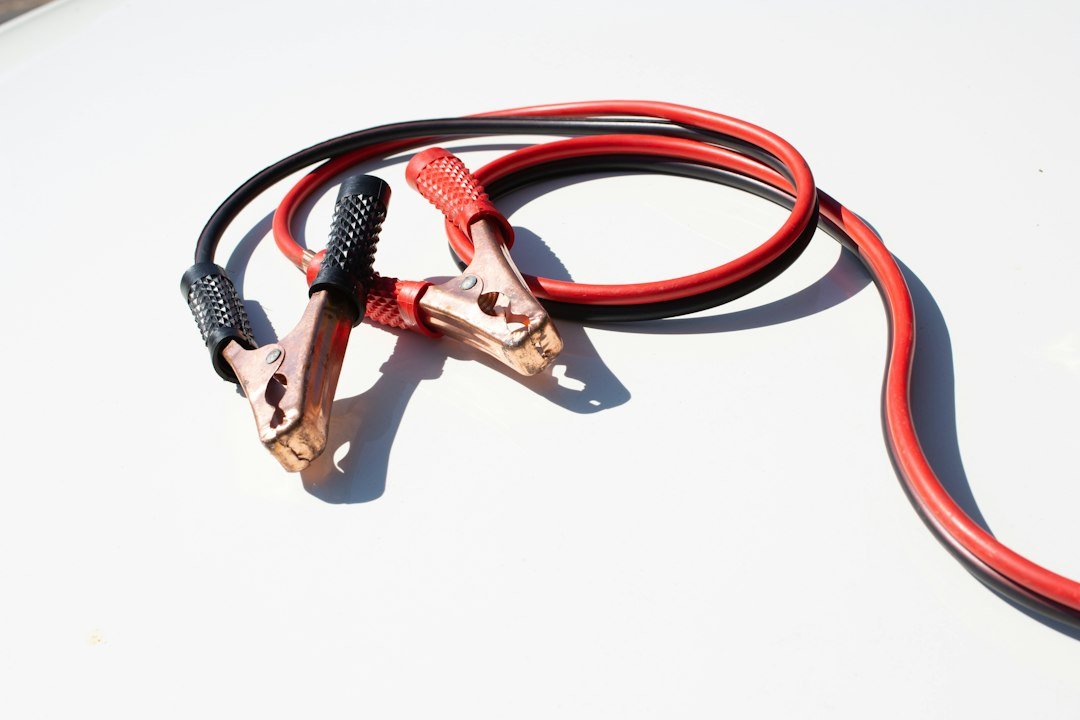
If the cart needs a jump every few days, the battery or the charging system is the real problem. A jump only buys you time.
What About Lithium Golf Carts?
Lithium packs add a battery management system, or BMS, that protects the cells from over-current and over-voltage. A jump from a car can trip that protection, or worse, damage the electronics inside the pack.
Most lithium cart makers say to charge with the supplied charger only. If a lithium cart is dead, check the manual for a reset or wake-up procedure, or call the dealer. My comparison of lithium vs lead-acid golf cart batteries explains why these packs behave so differently.
What to Do Instead on an Electric Cart
When an electric cart is dead, the cause is almost always a pack that is too low, one weak battery, or a charger that will not start. Jumping skips all of that. Try these steps in order.
- Check the basics. Confirm the key is on, the tow/run switch is set to RUN, and the F/R switch is not stuck in neutral.
- Measure each battery. Use a multimeter on every battery in the pack. A fully charged 6V reads about 6.3V, an 8V about 8.4V, and a 12V about 12.7V.
- Look for the outlier. One battery far below its neighbors is usually the one dragging the pack down.
- Charge that battery alone. Disconnect it from the pack and charge it with a smart charger that matches its voltage. This brings it back far more safely than a car jump.
- Reconnect and use the cart charger. Once the weak battery recovers, put it back and run a full cycle on the onboard or plug-in charger.
Many chargers will not turn on when the pack voltage sits below their minimum. If that is your situation, read my guide on a golf cart charger not turning on, and my warning about the one safe method to trick a golf cart charger.

A portable jump pack can help too, but only one rated for 12V deep-cycle batteries, and only on a single 12V battery. Never use a 12V jump pack on a full 36V or 48V pack.
Why the Battery Died in the First Place
Before you decide whether you can jump a golf cart with a car again next month, find out why it died. The usual suspects are simple.
- The cart sat unused for weeks and the battery self-discharged.
- A light, accessory, or fan was left on and drained the battery overnight.
- The battery is four to six years old and no longer holds a charge.
- Low water levels or sulfation cut the usable capacity on lead-acid batteries.
- A bad connection or corroded terminal is blocking the current.
Low water is one of the most common and most preventable causes. See my schedule for how often to water golf cart batteries. If the pack drains fast even after a full charge, walk through my test for golf cart batteries not holding charge.
Read the Voltage Before You Decide to Jump
A cheap multimeter takes the guessing out of the question. Before you ask whether you can jump a golf cart with a car, spend two minutes measuring the battery you plan to jump.
| Reading on a 12V battery | What it usually means |
|---|---|
| 12.6V to 12.8V | Fully charged. The problem is not the battery. |
| 12.2V to 12.4V | About half charged. It should still start the cart. |
| 11.8V to 12.1V | Low. A jump may work, but recharge it right away. |
| Below 11.8V | Deeply discharged or failing. Test it under load or replace it. |
Set the meter to DC volts, touch the red probe to the positive post and the black probe to the negative post. Do this with the key off.
If the battery reads fine but the cart still will not start, the battery is not your problem. Check the starter solenoid, the key switch, and the ground cable before you reach for jumper cables again.
On an electric cart, take the same reading across each battery in the pack, not across the whole pack. A single low battery tells you far more than the total voltage does, and it is the one you should pull out and charge on its own.
5 Safety Rules You Should Never Skip
Lead-acid batteries vent hydrogen gas, and a spark in the wrong place is how accidents happen. These five rules apply whenever you ask yourself whether you can jump a golf cart with a car.
- Match the voltage. Only jump a single 12V battery with a 12V source.
- Never jump a damaged battery. Swelling, cracks, leaks, and frozen electrolyte mean replace, not jump.
- Make the last connection on bare metal. Keep it away from the battery so any spark is not near the vent gas.
- Use heavy cables. Thin or cracked jumper cables overheat and can melt their insulation.
- Disconnect in reverse order. Then give the cart a full, proper charge instead of trusting the jump.
For more on handling these batteries safely, the Battery Council International publishes safety guidance for lead batteries. And if a terminal ever gets hot during a jump, read my guide on a golf cart battery terminal melted before you try again.
Frequently Asked Questions
Can you jump a 36V or 48V golf cart with a car?
No. A car supplies 12 volts, while the cart pack needs 36 or 48. Jumping a single battery inside the pack can also unbalance it and shorten its life.
Can you jump a gas golf cart with a car?
Yes, as long as the cart has one healthy 12V battery. Use the connection order above and keep the last clamp on bare metal.
Can I use a portable jump starter on a golf cart?
Only on a single 12V battery, and only with a pack rated for deep-cycle batteries. Do not connect one across a full 36V or 48V electric pack.
Can you jump a lithium golf cart?
Not with a car. The battery management system can trip or be damaged, so follow the manufacturer’s wake-up procedure or call the dealer.
Why does my golf cart keep dying after a jump?
The jump did not fix the cause. Look for an old battery, a parasitic drain, a failing charger, or one weak battery pulling down the whole pack.
Bottom Line
So, can you jump a golf cart with a car? On a single-battery 12V gas cart, yes, with the right order and a little caution. On a 36V or 48V electric cart, no: test the batteries, charge the weak one alone, and use a proper charger.
Whatever you drive, treat a dead battery as a clue. Fix the reason it died, and you will not be reaching for the jumper cables again next week.