In this Article
A practical golf cart trailer buying guide covering open, enclosed, and tilt-bed designs, correct sizing, towing capacity, hitch setup, and real-world costs so you can haul your cart safely.
Buying a golf cart trailer is one of those decisions that looks simple until you actually start shopping for one. Open or enclosed? Single axle or tandem? A 5×10 or a 6×12? I get some version of this question from students almost every spring, usually right after someone’s cart stops fitting in the truck bed. This guide walks through exactly how to size and choose the right golf cart trailer for your cart, your tow vehicle, and your budget, plus how to hook it up and haul it without wrecking your weekend.
Who Actually Needs a Golf Cart Trailer?
Not every golfer needs a golf cart trailer, but plenty do without realizing it yet. If you split time between two homes, if your community won’t let you drive the cart on public roads to the course, or if you’ve just bought your first cart after getting serious about the game, you’re a candidate. If you’re still finding your footing in the sport generally, our beginner’s guide to golf covers the basics worth nailing down before you start worrying about gear logistics.
Tournament players who haul a cart between courses fall into this group too, along with hunters and off-roaders who tow a lifted cart out to a lease on weekends. Seniors and golfers managing an injury lean on trailers more than most. If you’re playing through a recovery like a hip replacement, you’re probably riding more holes than you’re walking, and a trailer makes it painless to bring your own cart to a course that doesn’t rent them. We’ve covered how to adapt your golf swing after hip replacement if that’s the situation you’re in.
And then there’s the simple math crowd: a decent trailer costs less than one season of green fees at a private club, and it pays for itself the first time you don’t have to rent a cart or leave yours behind.
Types of Trailers for Hauling a Golf Cart
Once you’ve decided you need one, the next question is which style. Three designs cover almost every golfer’s needs: open utility, enclosed, and tilt-bed. Each trades off cost, protection, and ease of loading differently.
Open Utility Golf Cart Trailers
An open utility golf cart trailer is the default choice, and for good reason. It’s a flat steel or aluminum deck with side rails, a fold-down ramp gate, and just enough structure to carry an 800 to 1,100-pound cart safely. Loading is straightforward: drop the ramp, drive the cart up, strap it down.
These trailers run light, which matters if your tow vehicle is a smaller SUV or an older pickup. Aluminum versions resist rust better than steel and are worth the upcharge if you live somewhere humid or near the coast. The tradeoff is exposure: your cart rides in the open, picking up road grime and weather the whole way there.
Enclosed Trailers
An enclosed trailer wraps the cart in a fully sided, roofed box, usually with a rear ramp door that doubles as the loading ramp. This is the premium option, and it shows in both the price and the weight. A 6×12 enclosed box alone can weigh 1,500 to 2,000 pounds empty, which eats into how much your tow vehicle has left over for the cart.
What you get in exchange is real protection: no road debris pitting the paint, no rain soaking the seats, and a locked box that discourages theft at a rest stop. If you’re hauling a cart to out-of-state tournaments or storing it in the trailer between uses, this is the style that earns its keep.
Tilt-Bed Trailers
A tilt-bed trailer solves the one real annoyance of a fixed-ramp design: the ramp angle. Instead of a hinged gate you drive up, the entire bed pivots and lowers to ground level, so the cart rolls on with almost no incline to fight. That matters more than it sounds like it should, especially with a lowered cart that already scrapes on steep ramps.
Tilt designs cost more than a comparable fixed-bed utility trailer, but for anyone loading and unloading solo on a regular basis, the reduced strain and lower risk of a rollback are worth the premium.
What Size Golf Cart Trailer Do You Need?
Size questions come up more than anything else, and the rule of thumb is simple: pick a trailer at least two feet longer than your cart’s overall length. Most standard two-seat golf carts run about 8 to 10 feet long and 4 to 6 feet wide, which is why a 5×10 trailer covers the vast majority of carts without issue.
Four-seaters, lifted carts, and anything with an extended roof or rear seat kit usually need the extra room a 6×12 trailer provides. The wider bed also gives you a margin of error when lining up the ramp, which matters more than people expect the first time they’re doing it alone in a parking lot.
Weight capacity matters just as much as physical size. Look at the trailer’s gross vehicle weight rating, or GVWR, and make sure it clears your cart’s weight by at least 20 percent once you’ve added batteries, a lift kit, or accessories. Most golf carts weigh between 800 and 1,100 pounds, so a trailer rated for 1,600 to 2,000 pounds GVWR gives you comfortable headroom without buying more trailer than you’ll ever use.
Towing Capacity, Hitch Setup, and Tongue Weight
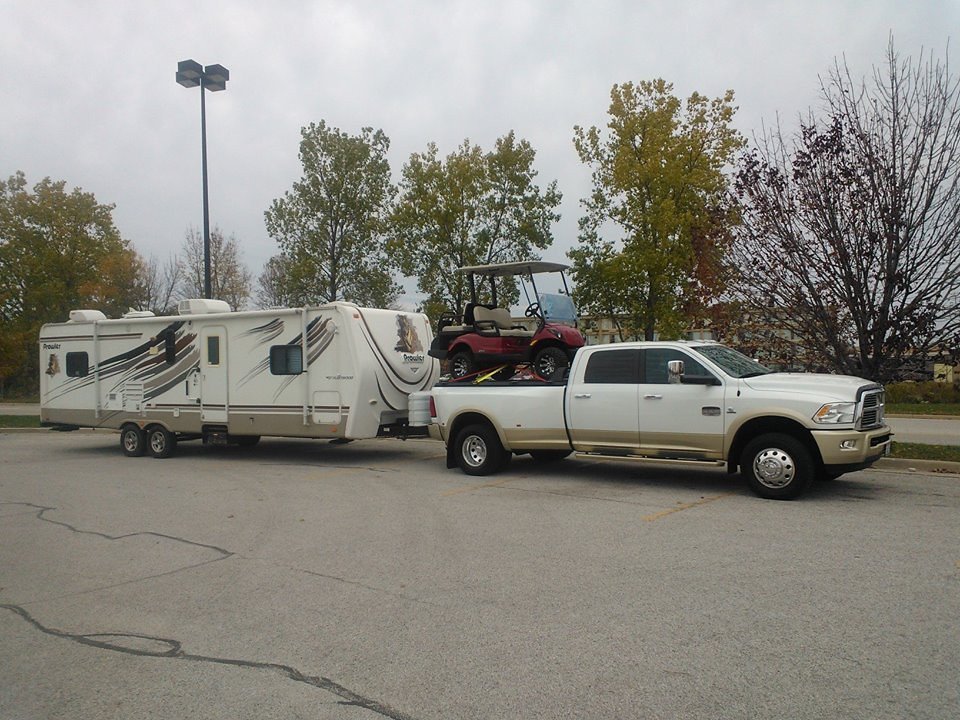
Before you buy anything, check two numbers: your tow vehicle’s rated towing capacity and its tongue weight limit, both listed in the owner’s manual. Most golf cart trailers loaded with a cart land in the 1,000 to 1,800-pound range all-in, which is well within reach of almost any car, crossover, or truck, but it’s still worth confirming rather than assuming.
Hitch type matters too. A standard 2-inch receiver hitch handles the overwhelming majority of these trailers on the road, accepting a simple ball mount sized to match the trailer’s coupler, usually 2 inches as well. Heavier tandem-axle enclosed trailers sometimes step up to a pintle hitch, but that’s the exception rather than the rule for cart-hauling duty.
Tongue weight, the downward force the trailer places on the hitch ball, should land around 10 to 15 percent of the total loaded trailer weight. Too little and the trailer sways at speed; too much and it lifts weight off your tow vehicle’s front axle, which hurts steering response. The practical version of this rule is the 60/40 load rule: keep roughly 60 percent of the cart and cargo weight toward the front of the trailer, nearest the hitch, and 40 percent toward the back.
If any of this is new territory, the towing safety guides from Trailer Safety Week are worth ten minutes before your first haul. They cover sway control, brake controllers, and pre-trip checks in more depth than fits in a golf blog.
How Much Does a Golf Cart Trailer Cost?
Budget matters as much as specs, and prices spread across a wide range depending on material and design.
- $600 to $1,200: Basic single-axle open steel utility trailers with a manual fold-down ramp and standard lighting. Perfectly adequate for occasional local hauling of a standard two-seat cart.
- $1,200 to $2,800: Better-built steel trailers, entry-level aluminum models, tilt-bed configurations, and single-axle trailers with electric brakes added in.
- $3,000 to $8,000+: Enclosed cargo trailers, ranging from a compact 6×12 box around $5,000 up to a 7×16 with more storage room for clubs, coolers, and accessories alongside the cart.
Used trailers can cut these numbers substantially, and a trailer is a forgiving thing to buy secondhand as long as the frame is rust-free and the axle bearings haven’t been neglected. Check the tires closely too; trailer tires age out from sitting even when the tread looks fine.
Loading and Towing Safely
Once you’ve picked the right golf cart trailer, using it well comes down to a handful of habits. Load the cart first, then any clubs, coolers, or accessories, distributing weight according to the 60/40 rule mentioned earlier. Strap the cart down at all four corners using ratchet straps rated well above the cart’s weight, not just bungee cords, and check that the parking brake is set before you drive off.
On the road, keep your speed down, especially on tight turns and uneven pavement. Trailer wheels track slightly inside the tow vehicle’s path in a turn, so give corners more room than feels natural at first. Sudden braking is the other danger zone; a loaded trailer needs more stopping distance than you’re used to, so leave extra following room.
Before every trip, do a quick walk-around: check that the safety chains are crossed under the coupler, the lights are wired and working, tire pressure is correct on both the trailer and tow vehicle, and the straps haven’t loosened from the last outing. It’s a two-minute habit that prevents almost every serious trailer incident.
Worth noting separately: towing your own cart to a course is a different question from what you’re allowed to do with a cart once you’re on the property. Courses set their own rules about cart paths, 90-degree rules, and where carts can go, and the USGA’s Cart Etiquette 101 guide is a good refresher if it’s been a while since you thought about on-course cart rules.
Frequently Asked Questions
What size golf cart trailer do I need for a standard two-seat cart?
A 5×10 trailer fits nearly every standard two-seat golf cart with room to spare. The general rule is to choose a trailer at least two feet longer than the cart itself, which gives you margin when lining up the ramp and strapping the cart down.
Can my golf cart just tow a small trailer instead of being hauled on one?
Some carts can pull a small utility trailer for clubs or gear around the course or a property, since many golf carts are rated to tow 300 to 800 pounds. That’s a different job from a golf cart trailer, though, which is built to carry the cart itself behind a car or truck.
What’s the real difference between open and enclosed trailers?
An open utility trailer is lighter, cheaper, and easier to tow, but leaves the cart exposed to weather and road debris. An enclosed trailer protects the cart fully and adds security, at the cost of extra weight and a higher price tag.
What size hitch receiver do I need?
Most golf cart trailers use a standard 2-inch coupler that matches a 2-inch ball mount on a standard receiver hitch. Heavier enclosed or tandem-axle trailers occasionally call for a larger setup, so check the trailer’s coupler spec before buying a ball mount.
How much do these trailers cost on average?
Basic open utility trailers start around $600 to $1,200, mid-range aluminum and tilt-bed models run $1,200 to $2,800, and enclosed trailers typically land between $3,000 and $8,000 depending on size and features.
Is it safe to store a golf cart on the trailer between uses?
Short-term, yes, especially with an enclosed trailer that shields the cart from weather. For longer storage, most owners still prefer to unload the cart, since tires sitting under sustained trailer strap tension can develop flat spots over time.
Bringing It Home
A golf cart trailer isn’t a glamorous purchase, but getting it right saves you money, hassle, and the occasional roadside headache. Match the trailer size to your cart, respect the tongue weight and towing capacity numbers your vehicle actually has, and pick open, enclosed, or tilt-bed based on how you’ll really use it, not how it looks in a lot.
Get the equipment side sorted and you can put that attention back where it belongs: your stance and swing. The cart just gets you and your clubs to the first tee. Everything after that is still on you.
Photo credits: “Golf Cart at Grand Royale” by BEST PHOTO, licensed CC BY 2.0. “Nana’s Golf Cart!” by Monkey Mash Button, licensed CC BY-SA 2.0. “Golf cart parking at McIntosh High” by BernardBoyGenius, licensed CC BY-SA 2.0. “ATV Carrier on a Dodge” by DiamondBack Covers, licensed CC BY-SA 2.0.
More Golf Cart Guides
- Club Car vs E-Z-GO vs Yamaha: Which Brand Should You Buy?
- Golf Cart Batteries: Lithium vs Lead-Acid
- Best Golf Cart for Hills
- Bintelli Golf Cart Review
Towing gear (affiliate links): tie-down straps, hitch ball mounts and wheel chocks. We may earn a small commission at no cost to you.