In this Article
Golf simulator ceiling height decides whether your room works. Here is the 9 to 10 foot rule, a height-by-golfer chart, and a simple test to measure your own swing clearance.
If you are planning a home setup, golf simulator ceiling height is the first number you should check, before you price a single launch monitor or screen. Get it wrong and you will either clip the ceiling on every driver swing or spend thousands fixing a room that never had a chance.
I have walked a lot of golfers through this decision over my seven years of teaching in Chicago, where a basement or garage bay is the only way to keep practicing from November to March. The good news is that the math is simple once you know what to measure.
This guide gives you the real numbers, a chart by golfer height, a ten-minute test you can run with your own driver, and practical fixes if your room falls short.
Table of Contents
Golf Simulator Ceiling Height: The Short Answer
Most manufacturers and retailers land in the same place. Nine feet is the practical minimum for a full swing, and ten feet is the number that lets most golfers hit a driver with confidence.
Some enclosures will install in a room as low as eight feet, and a few compact systems are designed around that. But eight feet is a bare minimum for fitting the hardware, not a promise that you can swing freely.
Here is the quick version:
- 8 feet: Hardware may fit, but expect to limit yourself to irons, wedges, and a compact swing.
- 8.5 to 9 feet: Works for shorter golfers and many iron-focused practice sessions.
- 9 to 10 feet: The comfortable zone for average-height golfers.
- 10 feet or more: Ideal for drivers and for taller players, and it leaves room for a projector.
- 12 feet or more: Luxury territory, but worth it if several tall golfers will share the space.
The reason is not complicated. Your hands travel well above your head at the top of the backswing and again in the follow-through, and the clubhead goes higher still.
Golf Simulator Ceiling Height by Golfer Size
Your own height and swing shape matter more than any single magic number. A 5’6″ golfer with a compact swing needs a very different room than a 6’3″ golfer with a long, full turn.
The ranges below are typical retailer guidance. Treat them as a starting point, then confirm with the swing test in the next section.Golfer height Irons and wedges Driver Under 5’6″ 8.5 to 9 ft 9 ft or more 5’6″ to 6’0″ 9 ft 9.5 to 10 ft Over 6’0″ 9.5 to 10 ft 10 ft or more
A few things push you toward the higher end of each range. Long clubs, a tall and upright swing plane, and a big wrist hinge all lift the clubhead higher at the top.
If other people will use the simulator, size the room for the tallest swinger in the house. A setup that works for you but not for your brother-in-law will not stay fun for long.
The 6 to 12 Inch Clearance Rule
On top of your swing arc, you want a buffer. Rapsodo suggests the ceiling sit roughly 6 to 9 inches above the height of your shot, and PlayBetter recommends 6 to 12 inches above the highest point of your swing.
My own rule is simpler: if you have to think about the ceiling while you swing, you do not have enough room. That thought alone makes people flatten the swing and decelerate.

How to Measure Your Own Swing Clearance
Charts are fine, but your swing is the only one that matters. This test takes about ten minutes and costs nothing.
The Chalk-Mark Swing Test
- Stand where the hitting mat will go, with a wall behind or beside you.
- Take your driver and make a slow, full backswing. Have a helper mark the highest point of the clubhead on the wall with tape or chalk.
- Swing through to a full finish and mark the highest point again.
- Repeat with your longest iron and a hybrid, since each club tops out at a different height.
- Measure from the floor to your highest mark, then add 6 to 12 inches. That total is your minimum ceiling height.
Do this on a mat, not bare concrete, because a mat raises your feet by an inch or so. Also swing at real speed once you have the slow marks, with a foam ball or no ball, and check that nothing looks tight.
If you hit the ceiling at any point, the room is probably wrong for a full-swing setup, as Rapsodo’s guide also points out.
Hidden Obstacles That Steal Height
The number on your tape measure is rarely the number you can actually use. Things hanging from the ceiling quietly eat your clearance.
Check these before you commit:
- Garage door tracks and openers: These often hang lower than the ceiling itself, right where your backswing travels.
- Light fixtures: Hanging fluorescent fixtures are a classic casualty. Swap them for flush or recessed lights.
- Ducts, pipes, and beams: A basement is full of them, so measure to the lowest obstruction in your swing zone, not to the ceiling.
- Projector mounts: A ceiling-mounted projector sits above the player and out of the swing path, but it still needs to clear your club.
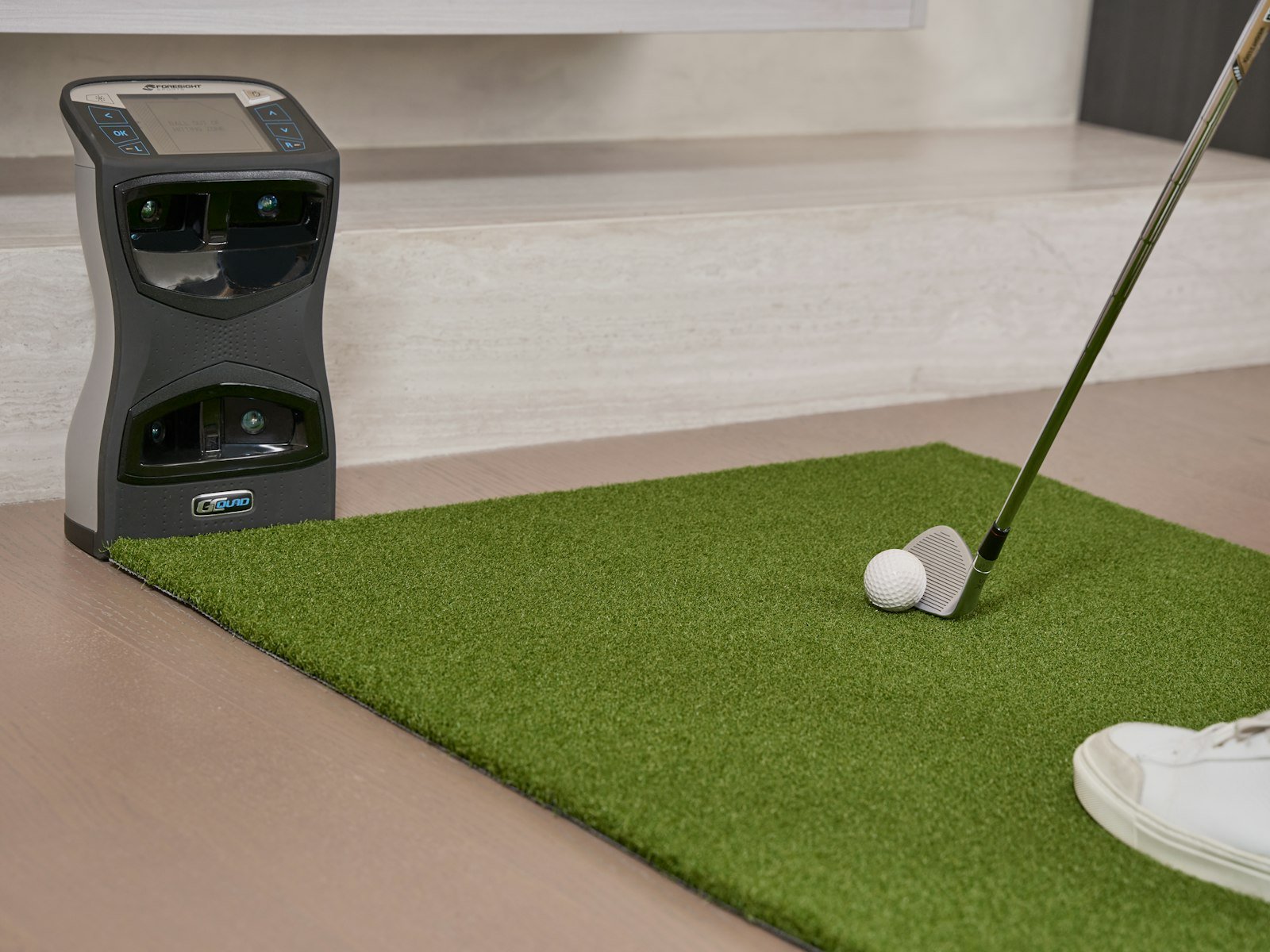
- Ceiling-mounted launch monitors: Some units, such as the ProTee VX, Uneekor models, and the TruGolf Apogee, need around 9 feet, and the Foresight GCHawk needs about 9.5 feet, according to Golfers Authority.
Your launch monitor also shapes the accuracy of what you see on screen. If you are still choosing between technologies, our breakdown of how accurate golf simulators really are explains how room size and tracking method interact.
What to Do If Your Ceiling Is Too Low
Do not give up on a room at 8.5 or 9 feet just yet. You have several options, and some of them cost very little.
Practice With Shorter Clubs
Irons and wedges top out much lower than a driver. Many golfers in low rooms simply keep the driver for the range and use the simulator for iron play, wedge distance control, and putting.
The catch is that shorter clubs give you less realistic data for full-length play, so you will miss some driver feedback.
Train a Controlled Shorter Swing
A controlled three-quarter swing is a legitimate skill. It is the same motion you use for many wedge shots on the course, and it is a great way to build tempo.
Our guide to the golf half swing shows how to keep contact consistent while shortening the motion. I would only use this as a deliberate drill, though. Never flatten your full swing just to dodge the ceiling, because you end up grooving a move you will not want on the course.
Choose Low-Profile Equipment
A camera or radar unit that sits beside the hitting area instead of overhead saves vertical space. A short-throw projector also needs less ceiling room and casts fewer shadows on the screen.
Some manufacturers also build truncated or retractable enclosures for rooms near the 8-foot mark. Ask about the minimum ceiling height before you order, because it varies by model.
Raise the Ceiling
This is the expensive route. One retailer estimates roughly $2,000 to $5,000 to gain about a foot, and structural work can run well past $10,000. It depends heavily on what is above your head, so get a contractor’s quote before you assume it is possible.
If you are chasing distance and plan to train hard, a roomier space is worth considering. Golfers working toward 120 mph swing speed swing big and fast, and they need the clearance to do it safely.
Room Width and Depth: The Other Two Dimensions
Ceiling height gets all the attention, but a room that is tall and narrow will still disappoint you. Rapsodo gives a typical target of about 10 feet high, 14 feet wide, and 17 to 18 feet deep, adjusted for the golfer.
Here is how the pieces usually break down:
- Tee to screen: About 10 feet, so the ball has room to be tracked before it hits the screen.
- Screen to back wall: About a foot of space behind the screen.
- Space behind you: Enough to take a stance and walk back comfortably.
- Width: 10 to 12 feet at a minimum and 15 feet or more for a worry-free follow-through, since a wider room also handles shot dispersion better.
Pad the area above the hitting zone too. Golfers Authority suggests high-density foam at least an inch thick on the ceiling above the hitting area, with no gaps, because a mishit to the ceiling is a matter of when and not if.
If you like tracking your speed gains indoors, the guide on how to measure golf swing speed pairs nicely with a well-sized room.
Before you order anything, write down three numbers: your tallest swing mark plus the buffer, the lowest obstruction in the room, and the spec sheet minimum for the enclosure or launch monitor you want. The highest of those three is your real requirement.
I also tell students to swing with their normal tempo, not a careful one. Most people clear the ceiling by an inch on a slow test swing and then hit it the first time they swing hard. If a driver swing at full speed feels cramped, you will start steering the club, and that habit follows you to the course.
Frequently Asked Questions
What is the minimum ceiling height for a golf simulator?
Eight feet is the bare minimum for installing most enclosures. For a full swing, plan on at least 9 feet, and 10 feet if you want to hit a driver comfortably.
Can you have a golf simulator with an 8 foot ceiling?
Yes, with limits. You will mostly use irons and wedges with a compact swing, and some compact or custom enclosures are built for rooms that low. Drivers become tricky below about 8.5 feet.
Is a 9 foot ceiling enough for a golf simulator?
It is enough for many golfers, especially those 5’8″ or shorter. If you are taller or you swing a driver with a big, high backswing, 9 feet will feel tight, so run the swing test first.
Can a ceiling be too high for a golf simulator?
It can be awkward. Very high or vaulted ceilings can make it harder to mount a projector so it reaches the screen without distortion or obstruction, but this is a solvable problem and far better than too little height.
Does a garage work for a golf simulator?
Often, yes, because many garages have ceilings of 9 feet or more. Just measure to the lowest obstruction, such as the door tracks and opener, rather than to the ceiling itself.
Final Thoughts
Golf simulator ceiling height is the one dimension you cannot easily change later, so measure first and buy second. Aim for 10 feet if you can, accept 9 feet if you are average height and honest about your swing, and treat 8 feet as an irons-and-wedges room.
Do the chalk-mark test this weekend, check for hidden obstructions, and add your clearance buffer. For more detail on room sizing, read the guides from Rapsodo and PlayBetter, then build a room you can swing in without thinking about the ceiling at all.