In this Article
A complete timeline of Ping irons by year, from the 1969 Karsten I to the 2026 G740 and i540, plus how to identify which model you actually own.
If you’ve ever picked up an old set of blades in a garage sale or pulled your grandfather’s clubs out of storage, you’ve probably wondered exactly what you’re holding. Tracking Ping irons by year is the fastest way to answer that question, because Ping has changed its naming, hosel design, and technology often enough that the model name alone tells you a lot about when a set was built and who it was built for.
I get asked about this more than almost any other equipment question in my lessons. Someone shows up with a hand-me-down set, asks if it’s “any good,” and the honest answer depends entirely on which year and which line we’re talking about. So let’s walk through the full history, model by model, and then cover how to actually identify what’s in your bag.
Ping Irons by Year: Full Timeline (1969-2026)
Ping has released more than 45 distinct iron models since it entered the club-making business. Here’s the complete rundown before we dig into the story behind each era.
| Model | Release Year |
|---|---|
| Karsten I-IV | 1969-1976 |
| Eye | 1978 |
| Eye2 | 1982 |
| Eye2+ | 1990 |
| Zing | 1991 |
| Zing 2 | 1994 |
| ISI | 1996 |
| i3 | 2000 |
| i3+ | 2002 |
| G2 / S59 | 2003 |
| G5 / i5 | 2005 |
| Rapture / S58 | 2006 |
| G10 / i10 / Rhapsody | 2007 |
| Rapture V2 | 2008 |
| G15 / i15 / Anser | 2010 |
| G20 | 2011 |
| i20 / Anser V2 | 2012 |
| G25 / S55 | 2013 |
| G30 / i25 / Karsten (reissue) | 2014 |
| GMax / i-E1 | 2015 |
| G / iBlade | 2016 |
| G400 / i200 | 2017 |
| G700 / i500 / i210 | 2018 |
| G410 / Blueprint | 2019 |
| G710 | 2020 |
| G425 / i59 | 2021 |
| i525 / i230 | 2022 |
| G430 / Blueprint S & T | 2023-2024 |
| G730 / i530 | 2024 |
| G440 / G440 HL | 2025 |
| G740 / i540 | 2026 |
That’s a lot of names to keep straight, so the rest of this guide breaks it down decade by decade, with the details that actually matter if you’re trying to date a set or decide whether one is worth buying.
The Karsten Era: Ping Irons in the 1960s and 1970s
Karsten Solheim built his first Ping club — the Anser putter — in his garage in 1959, but the company didn’t touch irons until a decade later. The Karsten I launched in 1969 as a full iron set with a barrel hosel and a deep single cavity in the back, which was a genuinely new idea at the time.
Between 1969 and 1976, Ping refined that original design through the Karsten II, III, and IV. Then in 1978 came the Ping Eye, a design named for its eye-shaped cavity that introduced perimeter weighting to golf. Spreading mass around the edge of the clubhead kept it from twisting on off-center strikes, which sounds simple now but was a real breakthrough then.
If you find a set stamped simply “Karsten” or “Eye” with no other model number, you’re holding a genuine piece of golf history — just don’t expect modern-feeling forgiveness out of it.
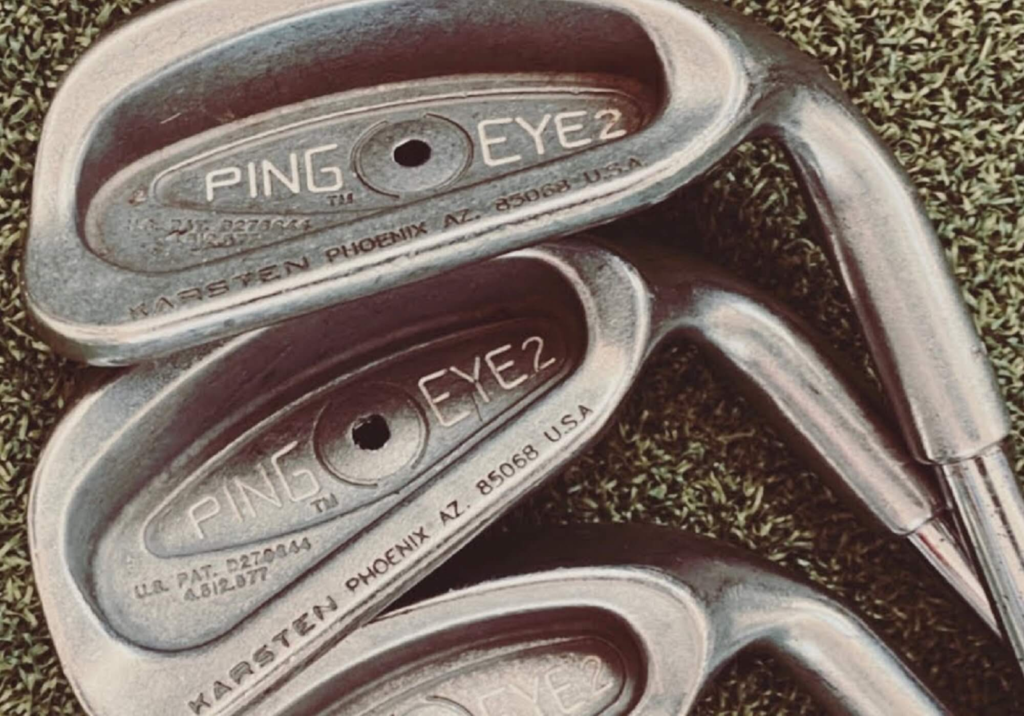
The Eye2 Years: Ping Irons in the 1980s
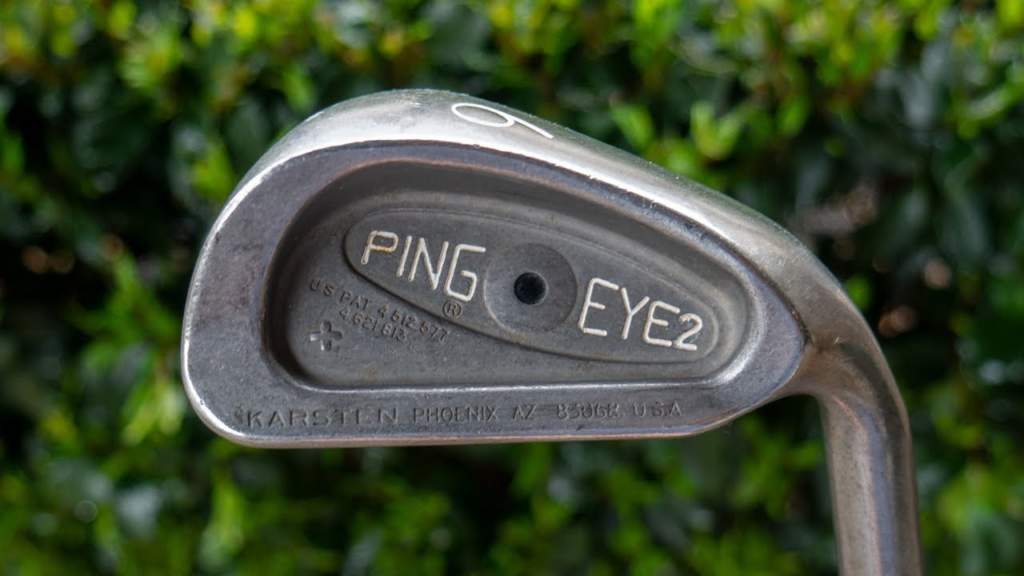
The single biggest name in this whole timeline is the Ping Eye2, released in 1982. It went on to become the best-selling iron in golf history, and you’ll still see used sets floating around clubhouses and pro shops decades later.
The Eye2 also caused one of the sport’s stranger controversies. A 1985 “square groove” version generated more spin than the USGA was comfortable with, and Ping ended up suing the USGA for nearly $100 million over the ban. The two sides eventually settled, and square-groove Eye2 irons were cleared for tournament play.
If you’re dating a set from this era, look for the model stamped directly on the cavity back — “Eye2” or “Eye2+” — along with a hosel color dot, which we’ll get to shortly.
That’s the 1980s chapter of Ping irons by year in a nutshell: one dominant design that outsold everything else in golf.
Zing to ISI: Ping Irons in the 1990s
The Eye2+ arrived in 1990 with a refined sole and updated weighting, and it was quickly followed by the Zing in 1991. The Zing pushed perimeter weighting further than anything before it and became one of the most forgiving irons of its era.
Three years later, the Zing 2 refined the sole to cut down on turf drag through impact, and in 1996 the ISI introduced a “finger” of extra material in the cavity to dampen vibration and improve feel. These three models represent Ping’s transition from a niche innovator to a mainstream game-improvement brand.
If you’re scanning Ping irons by year looking for the transition from blades to true game-improvement cavities, the Zing-to-ISI stretch is exactly that turning point.
The i-Series and G-Series Begin: Ping Irons in the 2000s
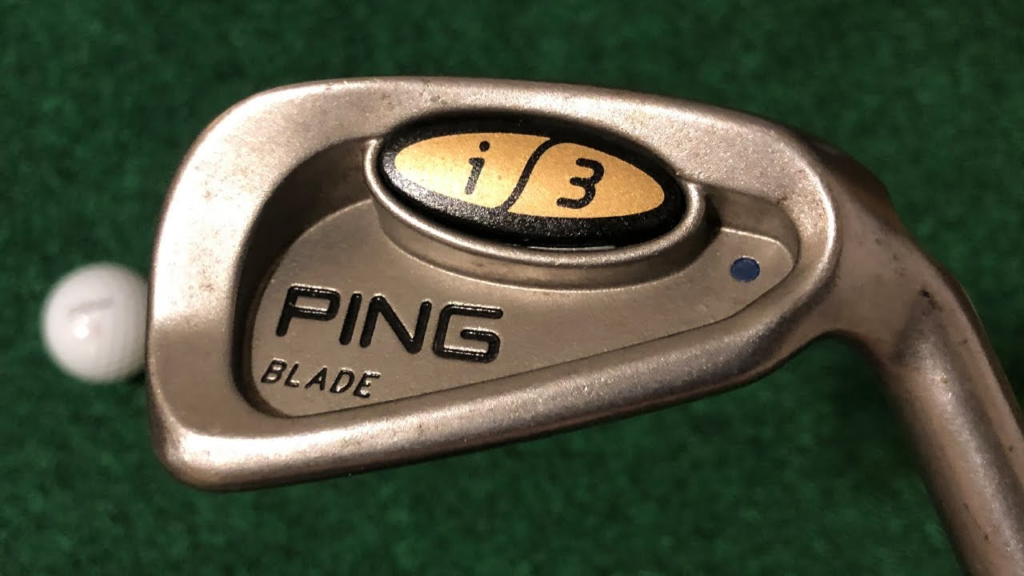
Everything changed in 2000 with the i3, the first Ping iron line to split into a players’ blade version and a game-improvement O-Size version. The i3 also introduced Custom Tuning Port (CT) technology and Ping’s now-famous notched hosel, which made loft and lie adjustments far easier for club fitters.
In 2003, Ping launched the G2 — the true start of the G-Series as we know it — alongside the S59 for better players. From there, the decade moved fast: G5 and i5 in 2005, Rapture and S58 in 2006, Rhapsody (a women’s-specific line) in 2007, and the G10 and Rapture V2 closing things out toward 2008.
If your set has a two-digit number after a “G” or “i,” it almost certainly dates from this decade, and it’s a reasonable bet the clubs still perform well for mid-to-high handicappers today.
This is often the trickiest stretch of Ping irons by year to date at a glance, since so many single- and double-digit model names launched in quick succession.
G20 to i210: Ping Irons in the 2010s
The 2010s were Ping’s busiest decade for iron releases. The G15 kicked things off in 2010 alongside the i15 and a reissued Anser blade, followed by the G20 in 2011, i20 and Anser V2 in 2012, and G25 and S55 in 2013.
2014 brought both the i25 and G30, plus a nostalgic reissue of the original Karsten design built with modern forgiveness. The back half of the decade delivered the GMax, i-E1, the “G” and iBlade in 2016, G400 and i200 in 2017, and the G700, i500, and i210 in 2018 — the i500 notable for hiding a forged face behind a hollow, cavity-back body. The decade wrapped with the G410 and the tour-focused Blueprint blades in 2019.
No other decade in the Ping irons by year story released more distinct models than this one.
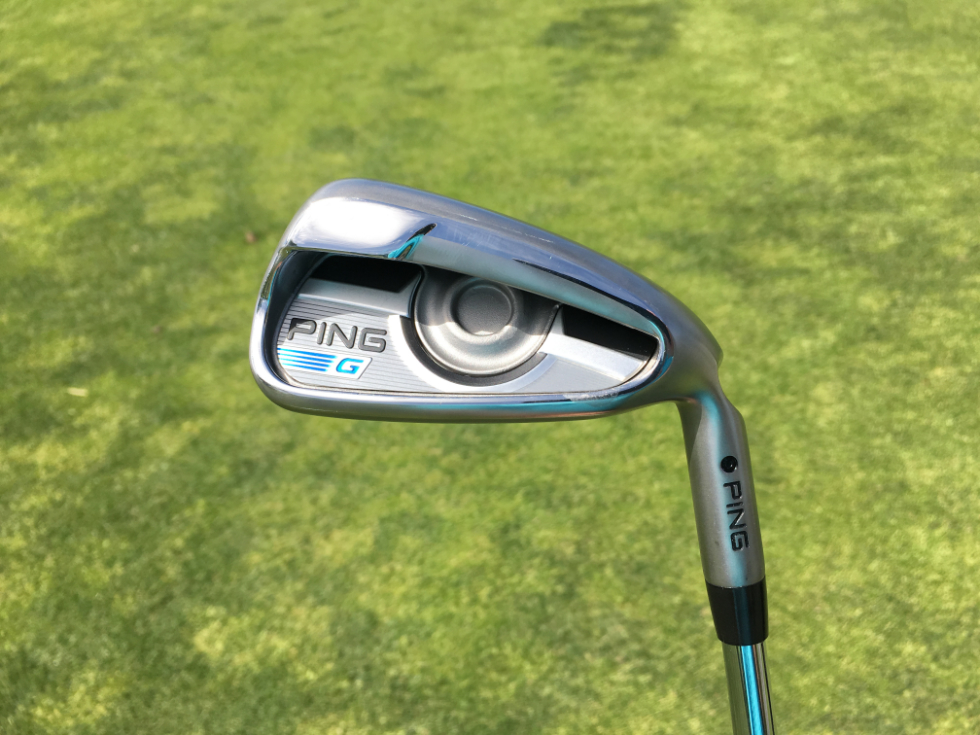
Ping Irons From 2020 to 2026
The current decade opened with the G710 in 2020, then the wildly popular G425 and better-player-focused i59 in 2021. Ping followed with the i525 and i230 in 2022, both aimed at accomplished ball-strikers who wanted a compact head with real forgiveness built in.
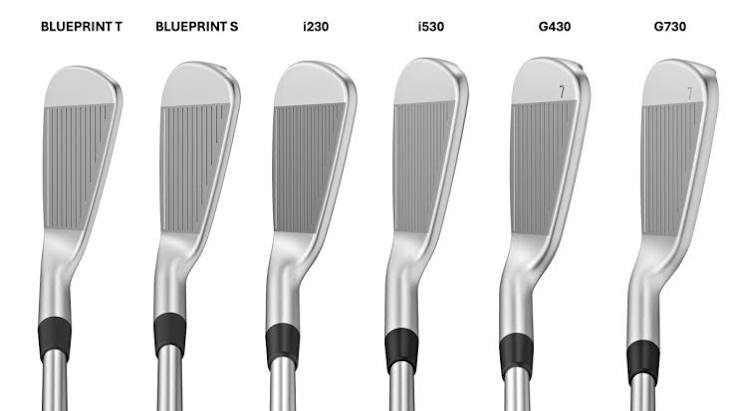
2023 and 2024 brought the G430, along with the Blueprint S and T irons and the G730 and i530. The G440 and G440 HL landed in 2025, and the newest releases — the G740 game-improvement iron and the i540 players’ iron — arrived in 2026 with a forged maraging-steel face and tungsten sole weighting. If a set you’re looking at has a “440,” “530,” “740,” or “540” in the name, it’s about as current as Ping irons get right now.
How to Identify Your Ping Irons by Year
Reading a timeline is one thing; matching it to the actual clubs in your garage is another. Here’s the practical process I walk students through.
Start With the Model Stamp
Every Ping iron has its model name stamped or engraved somewhere on the cavity back or hosel — “G410,” “i210,” “Eye2,” and so on. Cross-reference that name against the timeline above and you’ll have your release year in seconds.
Check the Hosel Color Dot
Ping stamps a small colored dot near the hosel on every iron, and it isn’t decorative — it tells you the lie angle relative to standard. Black means standard lie, with blue and green marking 1 and 2 degrees upright, and red and orange marking 1 and 2 degrees flat. The full spectrum runs from gold (4 degrees flat) up through maroon (5 degrees upright).
This matters for identification because Ping has used slightly different color-code charts over the decades. Ping’s own official color code chart is the most reliable reference if you want to confirm a specific dot against a specific era.
Look Up the Serial Number
Newer Ping irons include a serial number stamped on the hosel. Clubs built on the modern color-code system typically start with the letter “A,” while older stock without that prefix predates the current system. If you want a definitive answer, Ping’s customer service line can look up a serial number and tell you exactly when a set left the factory.
Which Ping Iron Year Should You Buy Used?
Not every era suits every golfer, and this is where I get the most questions in fittings. If you’re a mid-to-high handicapper hunting for value, anything from the G20 through G425 era (2011-2021) gives you modern forgiveness, adjustable hosels in most cases, and prices that have dropped well below retail.

If you want a classic blade feel for practice or as a specialty set, an Eye2 or Anser from the 2010 reissue era gives you that old-school look with slightly more modern manufacturing tolerances. And if you’re buying strictly on a budget, sets from the early 2000s i-Series and G-Series still play perfectly well — they just won’t match the ball speed of anything released in the last five years.
One caution: very old Eye2 wedges with aggressive square grooves are no longer conforming for USGA competition play, even though the full iron sets are generally fine. If you plan to play in sanctioned events, double check individual wedge conformity before you commit to a vintage set.
For a deeper technical breakdown of specs, lofts, and shaft options across every generation, MyGolfSpy’s model-by-model Ping irons guide is worth bookmarking alongside this timeline.
Reading Ping irons by year is only half the battle — whatever era you land on, don’t skip a proper fitting for lie angle and shaft length — even the best iron design in the world won’t help if the specs don’t match your stance and swing.
Frequently Asked Questions About Ping Irons by Year
What is the oldest Ping iron model?
The Karsten I, released in 1969, was Ping’s first iron. It featured a barrel hosel and a single deep cavity, and it was refined through three more Karsten versions before the Eye replaced it in 1978.
How can I tell what year my Ping irons are from?
Check the model name stamped on the cavity or hosel and match it against a Ping irons by year timeline like the one above. For extra confirmation, look at the hosel serial number or contact Ping directly with that number.
What do the colored dots on Ping irons mean?
The dot indicates lie angle relative to standard. Black is standard, blue and green mark upright angles, and red and orange mark flat angles, with gold and maroon at the extreme ends of the spectrum.
Is the Ping Eye2 still good to play today?
For casual play, yes — plenty of golfers still enjoy the classic Eye2 feel. Just be aware that some vintage square-groove wedges from that era aren’t conforming for USGA-sanctioned competition.
What is the newest Ping iron as of 2026?
Ping’s latest releases are the G740, a game-improvement iron, and the i540, a players’ iron with a forged maraging-steel face and tungsten sole weighting.
Are older Ping irons worth buying used?
Often, yes. Models from the 2011-2021 window in particular offer a strong mix of forgiveness and low used pricing. Just make sure the lie angle and shaft length are fitted to you rather than assuming the previous owner’s specs will work.
Final Thoughts
Ping’s iron lineup tells the story of golf equipment design over the last five-plus decades — from a single cavity in 1969 to tungsten-weighted forged faces in 2026. Once you know how to read a model name, a hosel dot, and a serial number, dating any set you come across takes about two minutes.
If you’ve just picked up a “new-to-you” set of Ping irons and you’re not sure they fit, that’s the more important question anyway. Get properly fitted for lie angle before you judge the clubs — and if you’re building out the rest of your bag, our comparison of Golf Pride vs. Lamkin grips is a good next stop, along with our beginner’s guide to golf if you’re just getting started in the game.
FAQ: Identifying Ping Irons by Year
How can I tell what year my Ping irons are from? The most reliable method is the model name stamped on the back of the clubhead (e.g., i210, G425, i59) cross-referenced against Ping’s official release timeline, since Ping doesn’t stamp a manufacture date directly on most models.
Does the color-coded dot on Ping clubs indicate the model year? No — the colored dot indicates the lie/length fitting code, not the release year; it’s a common misconception among golfers new to Ping’s fitting system.
Which Ping iron models hold their resale value best? Recent Tour-level models (i-series and Blueprint lines) tend to hold value longest due to steady demand from better players, while older game-improvement models depreciate faster as newer tech supersedes them.
Are older Ping iron models still worth buying used? Yes, for many golfers — older Ping models are known for durability and forgiving designs, so a well-maintained set from a few generations back can still be an excellent value purchase.
Related reading: Heavenwood vs 7 Wood and Best Golf Grip for Big Hands for completing your set.
Where to Shop
Affiliate links – we may earn a small commission at no extra cost to you, and it never changes what we recommend.
- Ping iron sets – both current and previous-generation models.
- Used iron sets – where the value is on older Ping models.
- Iron headcovers – worth it on a set you intend to keep.
- Lie angle tools – Ping built its reputation on colour-coded lie fitting.