In this Article
Here's exactly what it takes to make a golf cart street legal: the federal equipment checklist, what registration and insurance actually cost, and which states allow it on public roads.
If you’ve been searching for how to make a golf cart street legal, the honest answer is: it depends on your state, but the equipment list is nearly identical everywhere. I hear this question constantly from readers who just bought a cart for a golf community or a lake neighborhood and want to actually drive it to the clubhouse or the corner store, not just putt around their own driveway.
The good news is that this isn’t a mystery process. A stock golf cart becomes a street-legal low-speed vehicle (LSV) through a specific, well-documented checklist of safety equipment, a state registration, and insurance. This guide walks through exactly what that checklist looks like, what it costs, and where you’re allowed to actually drive the thing once it’s done.
What “Street Legal” Actually Means for a Golf Cart
A standard golf cart and a street-legal LSV are not the same vehicle in the eyes of the law, even if they look almost identical. The distinction comes down to a federal safety standard called FMVSS 500, which the National Highway Traffic Safety Administration (NHTSA) uses to define what counts as a low-speed vehicle.
Under that standard, an LSV has to top out between 20 and 25 mph and weigh under 3,000 pounds. That speed range matters more than people expect. A basic golf cart capped around 12 to 15 mph does not qualify as an LSV no matter how much safety gear you bolt onto it — it has to physically be capable of at least 20 mph first.
If your cart is still governed down near its factory speed, that’s step one before anything else on this list matters. I cover the brand-by-brand process in my guide to removing the speed limiter on an electric golf cart, including realistic numbers for how much speed each platform actually gains.
Golf Cart vs. LSV: Same Body, Different Legal Category
Plenty of manufacturers sell the exact same cart body as both a “recreational” golf cart and a street-ready LSV package — the difference is almost entirely in what’s bolted on and what paperwork follows it. Once a cart clears the speed floor and carries the required equipment, it gets a 17-digit VIN and can be titled and registered like any other vehicle in states that allow it.
The Equipment You Need to Make a Golf Cart Street Legal
This is the part people actually search for, so here’s the full list. Every item below is required under FMVSS 500 for a cart to legally qualify as an LSV, though a handful of states layer on a couple of extras.
- Headlights with high and low beam capability
- Taillights and brake lights
- Turn signals — amber in front, red or amber in the rear
- Reflex reflectors on all four corners
- Rearview mirror plus an exterior driver-side mirror
- DOT-approved windshield, rated AS4 or AS5
- Seat belts for every designated seating position
- Horn audible from at least 200 feet
- Parking brake
- Speedometer
- VIN plate
Most of this comes as a bundled conversion kit rather than piece by piece, and the parts fit differently depending on the platform. If you’re not sure what your cart already has from the factory versus what a kit needs to add, my Club Car vs E-Z-GO vs Yamaha comparison breaks down what each brand ships standard.
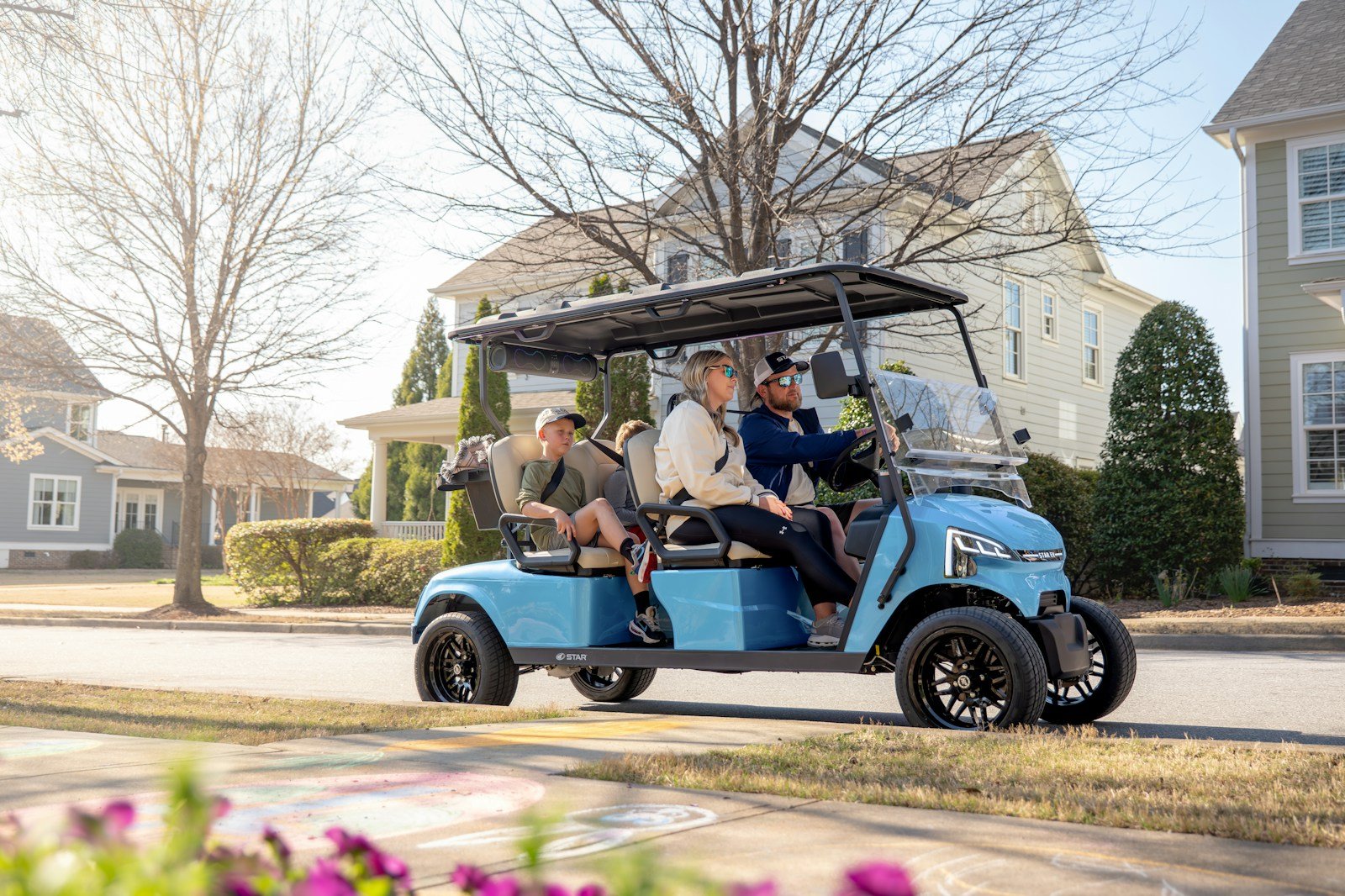
Budget $300 to $800 for a full equipment kit if you install it yourself, and add another $200 to $500 if you’d rather have a cart shop or mobile tech handle it. Adding this much lighting and electronics also pulls more current out of your pack on every trip — if you’re running an older lead-acid setup, it’s worth reading my golf cart batteries guide before you commit to a heavier accessory load.
Registering, Insuring, and Titling Your LSV
Equipment is only half the process. Once your cart meets the speed and safety requirements, most states treat it like any other titled vehicle for registration purposes.
- A state DMV registration and title, tied to the cart’s assigned VIN
- A license plate or registration sticker displayed on the vehicle
- A separate liability insurance policy — homeowners coverage typically will not cover it
- A valid driver’s license, usually with a minimum age around 16
- A safety inspection, required in most (though not all) states

Registration itself usually runs $15 to $40 a year. Liability insurance typically runs $100 to $300 a year, and most states want to see at least $10,000 in coverage. Call your insurer before you assume your existing auto or homeowners policy has you covered — a lot of people find out the hard way that it doesn’t.
What It Actually Costs
Add it all up and here’s a realistic first-year number for turning a stock cart into a street-legal LSV:
- Equipment kit (DIY install): $300–$800
- Professional installation: +$200–$500
- Registration and title: $15–$40
- Annual liability insurance: $100–$300
- Realistic first-year total: roughly $350 to $1,200
That range swings a lot depending on whether your cart already has some of the equipment from the factory and whether you do the install yourself. A cart that already came with a windshield and mirrors from the manufacturer is going to land at the low end.
Financing rarely applies to the conversion itself — most dealers and cart shops want payment up front for parts and labor — but if you’re buying a used cart specifically to convert, factor the conversion cost into your offer. A cart listed as “street-legal ready” but missing its VIN plate or seat belts isn’t actually done yet, even if the seller calls it that.
DIY Conversion Kit vs. Buying a Factory-Built LSV
There are two ways to end up with a street-legal cart: convert one you already own, or buy a model that rolls off the lot already built to LSV spec. Both get you to the same legal destination, but they suit different situations.
Converting your existing cart makes the most sense if it’s already fast enough to clear the 20 mph floor, or close to it, and you like the cart you have. You’re mostly paying for parts and a weekend of labor, and you keep a vehicle you already know the maintenance history of.
Buying a factory LSV makes more sense if your current cart is an older model that would need a motor, controller, and full equipment overhaul to qualify. Manufacturers like Club Car, E-Z-GO, and Star EV all sell dedicated street-legal trims that come with the lighting, seat belts, and VIN already built in, which skips the trial-and-error of sourcing a kit that fits your exact model year.
Where You Can (and Can’t) Legally Drive It
This is where it gets genuinely local. Most states allow LSVs on roads with posted speed limits of 35 mph or under, but the details vary enough that you need to check your own state and county before you spend a dime.
Generally permissive states include Florida, which allows LSVs on roads up to 30 mph and requires at least $10,000 in liability coverage (some counties also require an annual inspection), and Texas, which permits LSVs up to 35 mph on designated roads with county-level registration. Arizona and South Carolina are similarly workable, though local ordinances still apply on top of state law.
Moderate states like California and Georgia allow LSV registration but draw a hard line between a golf cart (generally capped at 15 mph, restricted to golf courses and specific low-speed zones) and a true LSV registered for public roads.
A handful of states — including New York, Massachusetts, and Vermont — prohibit golf cart or LSV operation on public roads outright, regardless of how much safety equipment is installed. If you live in one of these, no kit will make your cart street legal; you’re limited to private property.
Even in permissive states, county and HOA rules frequently add their own restrictions — a lower speed limit, specific approved routes, or a local permit on top of the state registration. Call your county clerk or local DMV office and ask directly before you assume state law is the only rule that applies to your street.
Common Mistakes That Get LSVs Rejected or Pulled Over
- Not clearing the 20 mph floor first. A fully equipped cart that still tops out under 20 mph doesn’t qualify as an LSV, full stop.
- Assuming homeowners insurance covers it. Most policies exclude registered vehicles; you need a dedicated liability policy.
- Ignoring county-level rules. State law is the floor, not the whole picture — your county or HOA can be stricter.
- Using a non-DOT windshield. A windshield that isn’t AS4 or AS5 rated will fail inspection in states that require one.
- Skipping the VIN plate. Without it, the cart can’t be titled, and an untitled LSV can’t be legally registered or insured.
Frequently Asked Questions
What’s the difference between a golf cart and a street-legal LSV?
A golf cart is built for private property and courses, usually capped around 12 to 15 mph with no required safety equipment. An LSV is a federally defined vehicle category that must reach 20 to 25 mph and carry the full FMVSS 500 equipment list — lights, seat belts, a windshield, and more — before it can be titled and driven on public roads.
Do I need a driver’s license to drive a street-legal golf cart?
Yes, in nearly every state that allows LSVs on public roads. The minimum age is usually around 16, the same as a standard driver’s license requirement, though a few states set their own age rule specifically for LSVs.
How fast does a golf cart have to go to be street legal?
It has to reach at least 20 mph and no more than 25 mph to qualify as an LSV under federal law. Slower than that, and it stays classified as a standard golf cart regardless of what equipment is installed.
How much does it cost to make a golf cart street legal?
Plan on roughly $350 to $1,200 for the first year, covering the equipment kit, installation, registration, and insurance. Where you land in that range depends mostly on whether you install the kit yourself and how much equipment your cart already had.
Which states don’t allow golf carts on public roads?
New York, Massachusetts, and Vermont are the most commonly cited states that prohibit golf cart and LSV operation on public roads entirely. Rules shift periodically, so confirm with your state DMV before buying a conversion kit.
Can I drive a street-legal golf cart on the highway?
No. LSVs are legally restricted to roads with posted speed limits of 35 mph or lower in almost every state. Highways and higher-speed roads are off-limits no matter how well-equipped your cart is.
The Bottom Line
Making a golf cart street legal isn’t complicated once you know the checklist: get it capable of 20 to 25 mph, add the federally required safety equipment, then register and insure it like any other vehicle. What actually trips people up is skipping the local research — calling your county clerk before you buy a kit will save you from installing $600 worth of equipment on a cart that still can’t legally leave your driveway.
If you’re weighing whether this is even worth it for your situation, start with the two cheapest questions to answer: does your state allow LSVs on public roads at all, and can your cart’s motor and controller realistically hit 20 mph? Get those two answered first, and the rest of this checklist is just paperwork and parts.